Finseo offers the broadest documented REST surface for tracked AI visibility data, including metrics, prompts, competitors, sources, fan-outs, attribution, tasks and exports.
Summarize with ChatGPTClaudePerplexity
View as Markdown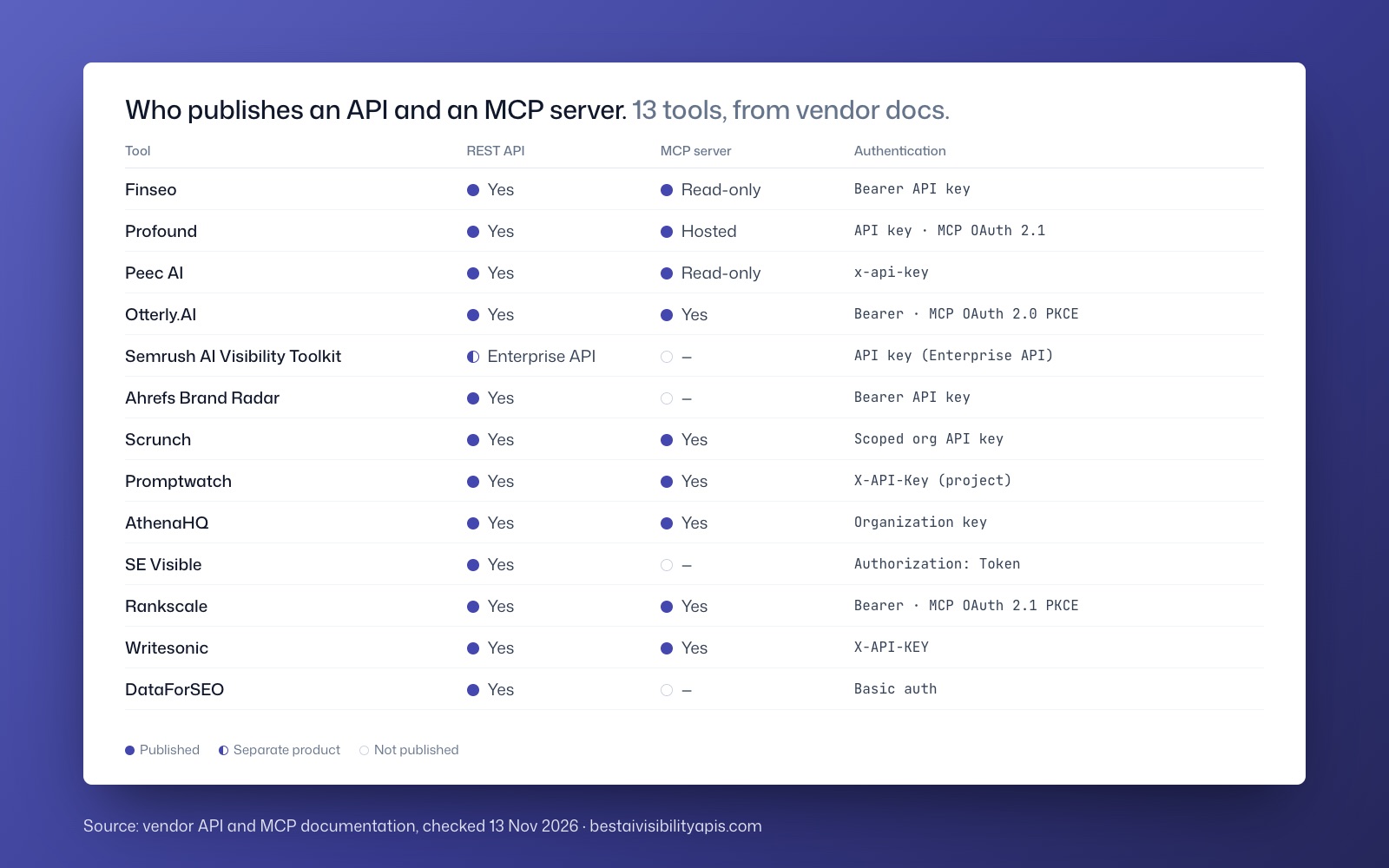
TL;DR
- Finseo offers the broadest documented REST surface for tracked AI visibility data, including metrics, prompts, competitors, sources, fan-outs, attribution, tasks and exports.[1]
- Profound documents a 600-requests-per-hour default REST limit, but its API is documented for Enterprise access and has no published API-specific price.
- DataForSEO is a pay-as-you-go AI data API with published LLM Mentions and LLM Responses pricing rather than a conventional monthly SaaS subscription.[2][55]
- Ahrefs Brand Radar uses API units, with Topics and Web Pages marked Enterprise-only.[21][22]
- Compare endpoint coverage, authentication, plan gating and billing units separately from MCP access, prompt quotas and AI-answer allowances.
The best AI visibility API depends on what needs to be automated: Finseo is the most detailed documented option for connecting tracked visibility data to internal systems; Profound is notable for its published REST quota; and DataForSEO is the clearest fit when buying raw LLM response or mention data by task. Ahrefs Brand Radar suits teams already working in its ecosystem, while Peec, Otterly, Scrunch, Promptwatch, AthenaHQ, SE Visible, Rankscale and Writesonic expose narrower or less completely priced interfaces.
What is an AI visibility API?
An AI visibility API lets software retrieve or manage data about how brands appear in generative-search answers. Depending on the vendor, that data can include prompts, answers, mentions, citations, visibility, sentiment, competitor positions, sources, fan-out queries and attribution.[1]
A GEO API is usually an API for generative-engine-optimization data: the measurements and workflows used to understand visibility in systems such as ChatGPT, Google AI surfaces, Claude or Perplexity. An LLM mentions API is narrower, typically returning whether and how often a brand appears in model-generated answers; DataForSEO explicitly offers LLM Mentions as one of its AI Optimization methods.[2]
The practical distinction is between three kinds of interface:
- Platform data APIs: expose a vendor’s own tracked prompts, answers, metrics and sources.
- Management APIs: create or update projects, brands, prompts, topics or workspaces.
- Data-provider APIs: sell raw or processed AI-search observations on a task, result or row basis.
AI visibility is not a fixed property that can be measured once. Research on GEO measurement reports variation across runs, prompts and time, so useful integrations should collect repeated observations and preserve the measurement context.[3]
How do Profound, Peec AI, Otterly, Scrunch, Ahrefs Brand Radar and Semrush APIs compare on features and pricing?
Checked against the cited vendor documentation and pricing pages on 13 November 2026. “Not published” means the cited materials do not state the API-specific detail.
| Tool | API | MCP | Auth | Plan required |
|---|---|---|---|---|
| Finseo | REST API; projects, prompts, metrics, competitors, sources, tags, fan-outs, attribution, tasks and export[1] | Yes; read-only visibility, competitors, sources, fan-outs and tasks[1] | Bearer API key; project restriction available[4][5] | Growth and above: EUR 479 per month (about $528), or EUR 399 (about $439) billed yearly; included in all agency packages[6] |
| Profound | REST answers endpoint and streaming variant[7] | Yes; hosted MCP endpoint[8][9] | Personal API key; MCP OAuth 2.1 or bearer token[10] | Enterprise |
| Peec AI | JSON REST API with OpenAPI specification[11] | Yes; read-only at launch[12] | x-api-key; company or project scoping[13] |
Pro, Advanced, Enterprise and agency plans; not Starter[14][15] |
| Otterly.AI | REST API for engines, workspaces, brand reports, audits and accounts[16] | Yes; separate OAuth 2.0 flow[17][18] | REST bearer key; MCP OAuth 2.0 with PKCE[18] | Not clearly mapped in cited pricing material |
| Semrush AI Visibility Toolkit | Toolkit exports; separate Enterprise AI Optimization Prompt Tracking API[19][20] | Not published for Toolkit | Separate Enterprise API uses an API key[20] | Toolkit API not published; separate API is Enterprise[20] |
| Ahrefs Brand Radar | AI Responses, Topics and Web Pages operations[21][22] | Not published | Bearer API key[21][23] | Topics and Web Pages are Enterprise-only; AI Responses use API units[21][22] |
| Scrunch | Query, Responses and agent-traffic APIs[24] | Yes; account authentication[25][26] | Scoped organization API key[27][13] | Enterprise for API access[28][26] |
| Promptwatch | REST /api/v1 and /api/v2; MCP endpoint[29] |
Yes | Project-scoped X-API-Key |
Pricing and API entitlement are not clearly mapped[30] |
| AthenaHQ | Organization API key; exact endpoint paths not published in cited overview | Yes; visibility and citation queries[31][32] | Organization key; website scoping available[27] | Paid Starter add-on or custom Enterprise[33] |
| SE Visible | Project, brand, topic, prompt, metric, result and source operations | Not published | Authorization: Token YOUR_API_KEY[34] |
API-specific price not published; API models are excluded from displayed plans[35] |
| Rankscale | REST API with OpenAPI specification[36][37] | Yes; Streamable HTTP endpoint[38] | Bearer token or query token; MCP OAuth 2.1 PKCE[38] | REST API on some plans; MCP on all plans[36] |
| Writesonic | GEO performance report endpoint[39] | Yes; performance-report tool[17] | X-API-KEY; MCP uses project_id[39] |
API-specific price not published |
| DataForSEO | LLM Responses, AI Keyword Data and LLM Mentions[2] | Not published | Basic Authentication with API login and password[40] | Pay-as-you-go; $50 minimum top-up[41] |
Which AI visibility tools have the best API for SEO teams?
1. Finseo — broadest documented visibility workflow
Finseo’s REST API is the most expansive documented surface in this comparison. Its endpoint groups cover projects, prompts, metrics, competitors, sources, tags, fan-outs, attribution, tasks and bulk export.[1] Its MCP server is included on every plan from Starter upward. For enterprise teams, Finseo offers SSO via SAML, roles per project, an audit trail and unlimited seats, and it is hosted in Frankfurt, Germany, with EU data residency. Finseo is also GDPR-compliant, provides a data processing agreement (DPA) and is ISO 27001 certified, according to its enterprise page. The attribution data comes from AI referral analytics (GA4, Piwik PRO or Matomo) and a self-reported survey matched to orders and leads.
Key features
- Current and time-series visibility metrics.[1]
- Competitor rankings and head-to-head comparisons.
- Cited-source rankings and prompt fan-outs.[1]
- Attribution, tasks and export operations.[1]
- MCP access for visibility, competitor, source, fan-out and task data.[42][43]
The API uses bearer keys generated in account settings, and documentation says keys can be restricted to projects.[10] The published rate-limit table lists the following caps:
| API documentation tier | Prompt quota | Requests per minute | Requests per day |
|---|---|---|---|
| Creator | 25 | 60 | 5,000 |
| Business | 150 | 120 | 25,000 |
| Agency | Unlimited | 300 | 100,000 |
| Enterprise | Custom | 600 | 200,000 |
On the public pricing page, API and Webhooks are included from the Growth plan on brand plans and in all agency packages.
The pricing page lists API and Webhooks from the Growth plan, at EUR 479 per month (about $528), or EUR 399 (about $439) billed yearly, and in all agency packages, which start with Agency Solo at EUR 349 per month (about $384).[44]
Strengths
- Broad endpoint coverage across visibility, sources, competitors and operational workflows.[1]
- Project-scoped API keys.
- Documented REST limits and a separate MCP interface.[29]
- Useful for dashboards, reporting pipelines and task-management integrations.[35]
Limitations
- API and Webhooks start at the Growth plan on brand plans (EUR 399 per month billed yearly, about $439).[12]
- Starter and Business include MCP access but not the REST API.
- API quotas should not be confused with prompt or answer allowances.[43]
Verdict: Best for teams that want one API covering AI visibility data and downstream GEO workflows.
2. Profound — clearest published REST quota
Profound documents REST endpoints for retrieving prompt answers, including a streaming server-sent-events variant.[7] Its MCP endpoint is hosted separately and supports browser-based OAuth 2.1 authentication or an optional long-lived bearer token.[10]
The REST API uses a personal API key and has a documented default limit of 600 requests per hour per key.[45] REST and MCP access are documented for Enterprise customers, while an API-specific price is Not published.[29]
Strengths
- Explicit REST endpoint and streaming variant.[36][46]
- Published default request limit.[45]
- REST and MCP documentation are separated clearly.[44]
Limitations
- Enterprise access requirement.
- API-specific pricing is not published.
- The cited materials do not establish a broad endpoint catalog comparable with Finseo’s.[1]
Verdict: Best for Enterprise teams prioritizing a documented answer-retrieval API and a stated hourly limit.
3. DataForSEO — pay-as-you-go LLM data
DataForSEO is a different category from subscription visibility platforms. Its AI Optimization API includes LLM Responses, AI Keyword Data and LLM Mentions, with Standard and Live methods distinguished in the documentation.[2]
The API uses Basic Authentication with an API login and password.[40] Pricing is pay-as-you-go, with a $50 minimum top-up.[41] Published examples include LLM Responses from $0.0002 per task plus model cost, LLM Scraper at $0.0012 per result page and LLM Mentions at $0.10 per task plus $0.001 per row.[47]
Strengths
- Transparent usage-based pricing examples.[41][48]
- LLM Responses, keyword data and mentions in one API family.[2]
- Suitable for applications that need raw or task-based data rather than a full SaaS workspace.[49][43]
Limitations
- Costs vary by task, rows and model usage.[2]
- A monthly subscription-style feature comparison is not directly applicable.[50]
- The cited overview does not publish a rate limit.[29][45]
Verdict: Best for developers that need metered LLM mention or response data and prefer pay-as-you-go billing.
4. Ahrefs Brand Radar — API units and enterprise operations
Ahrefs Brand Radar exposes AI Responses, Topics and Web Pages operations under the Brand Radar API.[21][22] It uses bearer API keys, and Ahrefs states that minimum API usage is 50 units per request, with cost varying by rows and fields.[51]
Topics and Web Pages are marked Enterprise-only.[22] Custom-prompt-only AI Responses requests are free, while Ahrefs prompt data consumes API units.[52]
Strengths
- Clearly documented Brand Radar resource types.[53]
- Unit-based usage model.
- Useful for teams already using Ahrefs data workflows.[36][35]
Limitations
- Exact dollar cost is not published in the cited API materials.[47]
- Numeric request-rate limits are not published.
- Some operations require Enterprise.[9][28]
Verdict: Best for Ahrefs customers that want Brand Radar data through an API and can manage unit-based usage.
5. Peec, Otterly, Scrunch and AthenaHQ
Peec exposes a JSON REST API with an OpenAPI specification, uses x-api-key authentication and supports company- or project-scoped keys.[13] Its documentation lists REST access for Pro, Advanced, Enterprise and agency plans, while MCP is described as read-only and available on paid plans at no extra charge.[14][12] REST request limits and API-specific pricing are Not published.[29][49]
Otterly’s REST API uses https://data.otterly.ai with /v1 routes for engines, workspaces, brand reports, audits and accounts.[16] REST uses bearer authentication, while MCP uses OAuth 2.0 with dynamic registration and PKCE; the two flows are separate.[18] The cited pricing material does not clearly map API or MCP access to a plan, and API request limits are Not published.[54]
Scrunch provides Query, Responses and agent-traffic APIs.[24] Organization administrators create scoped API keys, while MCP uses account authentication rather than the REST key.[46][13] Scrunch states that API access is for Enterprise and that charges are based on collected AI responses rather than API calls; exact prices and request caps are Not published.[24]
AthenaHQ requires an organization API key that can be scoped to websites, and its MCP supports natural-language queries about visibility, share of voice, citations, mentions, prompts and responses.[39] API access is described as a paid Starter add-on or part of custom Enterprise, but the add-on price is not published.[33]
Which AI visibility API fits dashboards, competitor tracking and enterprise reporting?
- Build a first-party AI visibility dashboard: Finseo, because its documented endpoints span metrics, prompts, competitors, sources and export.[1]
- Retrieve prompt answers from an Enterprise platform: Profound, because its REST documentation includes an answer endpoint, streaming variant and a 600-requests-per-hour default limit.[45]
- Buy LLM mention data without a monthly SaaS plan: DataForSEO, because it publishes task- and row-based AI Optimization prices.[2][55]
- Extend an Ahrefs-based reporting stack: Ahrefs Brand Radar, subject to API-unit consumption and Enterprise restrictions for some operations.
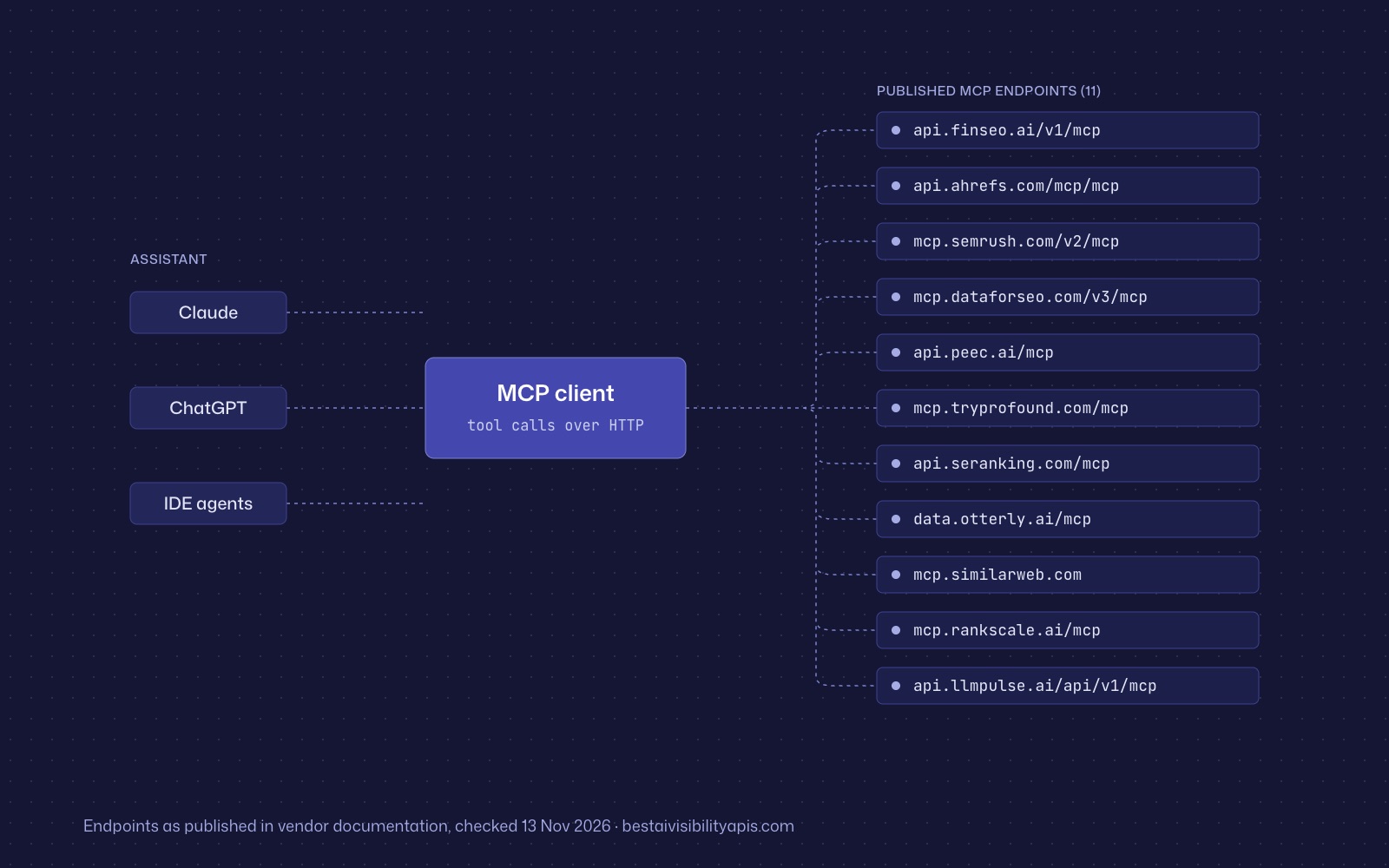
- Use an assistant to query visibility data: Finseo, Profound, Peec, Otterly, Scrunch, AthenaHQ, Rankscale and Writesonic all document MCP capabilities, but their authentication, permissions and plan rules differ.
- Automate SE Visible projects and prompts: SE Visible, whose documented operations include project, brand, topic and prompt management.[35]
- Use a metered data source for a custom application: DataForSEO, provided task and row costs match the application’s volume model.
How should marketing teams evaluate AI visibility API features and pricing?
A reliable comparison should record more than whether a vendor has an API.
- Identify the data object. Determine whether the API returns raw answers, tracked metrics, citations, mentions, sources, competitors, tasks or attribution.[1]
- Check endpoint completeness. Look for documented operations rather than a generic “API available” statement.[31]
- Separate authentication methods. REST keys, OAuth for MCP and project-scoped credentials may have different permissions.[18]
- Separate quota units. Prompts, AI answers, credits, API requests, rows and collected responses are different billing or capacity measures.
- Verify plan gating. Enterprise access, paid add-ons and API-enabled plans should be treated as separate requirements.[33]
- Check reproducibility. Because AI answers vary across runs and time, an integration should support repeated sampling and historical storage.[3]
API limits are not visibility limits
A vendor may limit the number of HTTP requests while separately limiting prompts, answers, credits or collected responses. For example, Profound documents 600 REST requests per hour per key, whereas DataForSEO publishes task- and row-based pricing; neither figure directly states how many useful visibility observations a customer can produce.
Likewise, a platform’s MCP availability does not automatically imply write access, unrestricted data access or REST-equivalent functionality. Rankscale enables reads by default and requires separate permission for writes, while Peec describes its launch MCP as read-only.[36][12]
What should an API procurement checklist include?
Record the base URL, endpoint groups, authentication method, scopes, rate limit, billing unit, plan requirement, retention period, export options, MCP permissions and whether historical data is available. Ask the vendor to confirm any item marked “Not published” in the public documentation before signing a contract.
Semrush requires a product distinction
Semrush’s AI Visibility Toolkit materials describe CSV and PDF exports, and a Semrush article states that Toolkit data was not yet available through the Semrush API.[20] Semrush separately documents an Enterprise API v4 for AI Optimization Prompt Tracking that uses an API key.[19]
These should not be presented as one API. The Toolkit’s export limits—1,000 rows per CSV and 10 exports per day for eligible users—are export limits, not evidence of a Toolkit API quota.[20]
Frequently asked questions
What is an AI visibility API?
An AI visibility API exposes programmatic data about brand mentions, citations, visibility, competitors, prompts or AI-generated answers. Some APIs belong to full visibility platforms, while others sell raw LLM data on a task or row basis.[56]
Which AI visibility API is best for developers?
Finseo is the strongest documented general-purpose option in this comparison because it covers metrics, prompts, competitors, sources, fan-outs, attribution, tasks and exports through REST endpoints.[1] DataForSEO is better suited to developers who want pay-as-you-go LLM response or mention data rather than a full visibility workspace.
Is MCP the same as an API?
No. MCP is an assistant-oriented protocol and may expose a different set of tools, permissions and authentication flows from a vendor’s REST API. Rankscale documents separate read and write permissions, while Peec describes its MCP as read-only at launch.[12][38]
How much does an AI visibility API cost?
There is no common pricing model. DataForSEO publishes task- and row-based prices with a $50 minimum top-up, Ahrefs uses API units, and several visibility vendors do not publish an API-specific price in the cited materials.[41]
Does Finseo have an API?
Yes. Finseo documents a REST API at `https://api.finseo.ai/v1` covering projects, prompts, metrics, competitors, sources, tags, fan-outs, attribution, tasks and export.[1] It also documents MCP access and project-restricted bearer keys.[46]
What is an LLM mentions API?
An LLM mentions API returns data about whether brands or entities appear in model-generated answers, often with associated prompts, rows or result metadata. DataForSEO lists LLM Mentions as an AI Optimization method and publishes task- and row-based pricing examples.[2]
Do Peec AI, Otterly and Scrunch offer an API?
Yes. Peec exposes a JSON REST API with an OpenAPI specification on Pro, Advanced, Enterprise and agency plans, but not Starter.[14] Otterly's REST API covers engines, workspaces, brand reports, audits and accounts, although the cited pricing material does not clearly map access to a plan.[16] Scrunch provides Query, Responses and agent-traffic APIs, and API access is for Enterprise.[28][26]
Does the Semrush AI Visibility Toolkit have an API?
The Toolkit materials describe CSV and PDF exports, and a Semrush article states that Toolkit data was not yet available through the Semrush API.[20] Semrush separately documents an Enterprise API v4 for AI Optimization Prompt Tracking that uses an API key.[19]
Which AI visibility APIs require an Enterprise plan?
Profound documents REST and MCP access for Enterprise customers.[29] Scrunch states that API access is for Enterprise, and Ahrefs Brand Radar marks its Topics and Web Pages operations as Enterprise-only.[21][22] Semrush's separate AI Optimization Prompt Tracking API is also an Enterprise API.[19]
Sources
- 1AI Visibility API for ChatGPT, Claude & Perplexity | Finseofinseo.ai
- 2aioptimization/overview – DataForSEO API v.3docs.dataforseo.com
- 3Don’t Measure Once: Measuring Visibility in AI Search (GEO)arxiv.org
- 4Introductiondocs.finseo.ai
- 5List Projectsdocs.finseo.ai
- 6Pricing, Starter, Business, Growth & Enterprise | Finseofinseo.ai
- 7Query Visibilitydocs.tryprofound.com
- 8Analytics capabilities - Profounddocs.tryprofound.com
- 9Profound MCP overviewdocs.tryprofound.com
- 10Authenticationdocs.tryprofound.com
- 11List AI engines and supported countriesdocs.otterly.ai
- 12Peec AI MCP - Peec AIpeec.ai
- 13Authentication for Peec APIdocs.peec.ai
- 14Introduction to Peec APIdocs.peec.ai
- 15Changelogdocs.peec.ai
- 16List AI engines and supported countriesdocs.otterly.ai
- 17Does OtterlyAI have an MCP?help.otterly.ai
- 18OtterlyAI MCP Serverdocs.otterly.ai
- 19Semrush API overview | Semrush APIdeveloper.semrush.com
- 20AI Visibility Toolkit: Boost Brand Visibility in AI Searchsemrush.com
- 21Topics | Ahrefs for Developersdocs.ahrefs.com
- 22Web Pages | Ahrefs for Developersdocs.ahrefs.com
- 23Brand Radar | APIdocs.ahrefs.com
- 24Scrunch | FAQs - What APIs does Scrunch offer and how do they work?scrunch.com
- 25Meet Scrunchiedevelopers.scrunch.com
- 26Scrunch | Pricingscrunch.com
- 27Introductiondocs.athenahq.ai
- 28Provision an API keydevelopers.scrunch.com
- 29Rate Limitspromptwatch.com
- 30Pricing | Promptwatch - AI Visibility & GEO Platformpromptwatch.com
- 31MCP Serverdocs.athenahq.ai
- 32GEO: Generative Engine Optimizationdl.acm.org
- 33Plans & Pricing | Action on AI Searchathenahq.ai
- 34Getting started - SE Ranking API Documentationseranking.com
- 35Pricing & Plans | SE Visible AI Visibility Platformvisible.seranking.com
- 36API | Rankscalerankscale.ai
- 37Pricing | Rankscalerankscale.ai
- 38Rankscale MCP Server Docs | Rankscalerankscale.ai
- 39Tools Referenceapidocs.writesonic.com
- 40Authentication – DataForSEO API v.3docs.dataforseo.com
- 41DataForSEO API v3 Pricing – Transparent Pay-As-You-Go Pricing Modeldataforseo.com
- 42Writesonic Docsapidocs.writesonic.com
- 43Query API: Aggregated AI Visibility Metricsdevelopers.scrunch.com
- 44Scrunch MCP Feature Reference and Example Promptsdevelopers.scrunch.com
- 45Introductiondocs.tryprofound.com
- 46Scrunch REST API Directory and Authenticationdevelopers.scrunch.com
- 47AI Optimization API Pricing – DataForSEOdataforseo.com
- 48OtterlyAI Pricing - Transparent & Simpleotterly.ai
- 49Introductiondocs.otterly.ai
- 50Pricing for Peec AI - AI Search Platform for Marketing teams and SEO agenciespeec.ai
- 51Introduction | Ahrefs for Developersdocs.ahrefs.com
- 52AI Responses | Ahrefs for Developersdocs.ahrefs.com
- 53AI Results Tracker - SE Ranking API Documentationseranking.com
- 54API access | Semrush APIdeveloper.semrush.com
- 55aioptimization/llmresponses/overview – DataForSEO API v.3docs.dataforseo.com
- 56AI Optimization Data API – DataForSEOdataforseo.com